Piran from Ljubljana: The Garage Outside the Walls, a Square That Was a Harbor, and Seven Centuries of Salt
An hour and a half southwest, Slovenia’s Venetian jewel runs car-free inside its walls — a campanile copied from St Mark’s, a square that was the harbor until the 1890s, and salt pans working seven centuries on.
The short version
- Buses run Ljubljana to Piran in about ninety minutes at modest fares, arriving beside the old town; drivers use the Fornače garage outside the walls with its shuttle, per the alarm’s sincere-enforcement clause — the car-free zone is policed as advertised.
- The Venetian layer is structural: five centuries under the Republic left the loggia-and-campanile grammar intact, with the bell tower a scaled quotation of St Mark’s — climbable for a couple of euros and worth every rung for the roofscape.
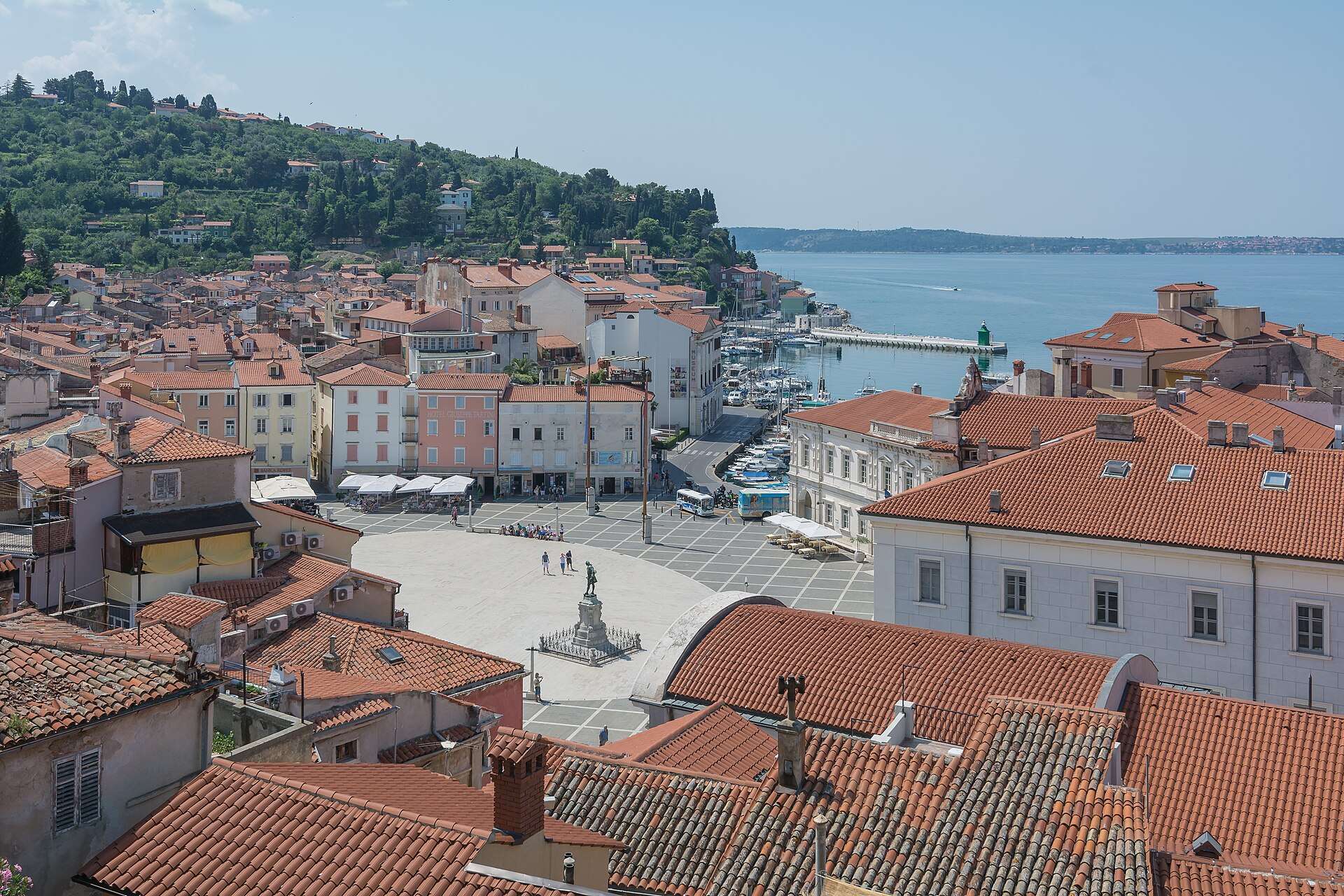
- Tartini Square’s oval is explained by its past per the alarm: the inner harbor until it was filled in the 1890s, now the marble living room of the town, ringed by the theatre, the Venetian House’s corner balcony, and the statue of Giuseppe Tartini — the violinist-composer born here in 1692.
- The medieval walls above town walk for a small fee: seven towers, the full amphitheater of red roofs against the Adriatic, and the photograph every visitor leaves with.
- The swimming truth per the alarm: Piran has no sand — the town swims off rocks, concrete platforms, and ladders along the promenade, and the water’s clarity settles any complaint; water shoes are the local concession.
- Piran salt is the souvenir with provenance: the Sečovlje pans down the coast have worked since the 13th century, the fleur de sel (solni cvet) is the premium tier, and the town’s shops sell it at source honesty; seafood — grilled fish, mussels buzara — is the eating register.

Getting there
The bus removes everything the alarm warns about — walk-on arrival, no garage arithmetic — while drivers accept the Fornače structure and its shuttle as the town’s terms. The lanes do the rest: Piran is a peninsula small enough that no plan survives better than wandering with the sea as your handrail. Summer weekends fill the garage and the promenade by late morning; the early start is the whole strategy.
The day
Tartini Square first while the light rakes it — the oval read correctly as the drowned harbor it was — then the lanes’ slow spiral upward: the parish church’s terrace, the campanile’s ladder-stairs for the full red-roof amphitheater, and the walls’ towers for the wider frame of Adriatic and Istrian hills. Descend to the point: the lighthouse, the promenade’s swimming ladders, and the rock-platform interval the alarm licensed — the water is the town’s best room. Lunch runs seafood at the front or konoba-style in the lanes; the afternoon browses the salt shops, the Venetian House’s balcony corner, and the small maritime museum for the Tartini violin and the salt-trade story. The Sečovlje pans themselves extend the day for drivers — the working landscape, the museum, the birdlife. The evening bus or shuttle-and-drive home runs against the sunset the promenade was built to watch.
When to go
May through September is the full sea-and-stone version — swimming from late spring, terraces at capacity, and the early-start rule at maximum value. April and October run the connoisseur’s quiet: walkable, open, and golden-lit without the crowd. Winter strips it to essentials — bora winds, empty lanes, and the square’s marble under low sun — a moody, valid half-day for the passing. The salt harvest’s traditional peak (summer) animates the pans; the town’s Tartini festival brings chamber music to the square’s acoustics in season.
Frequently Asked Questions
Is the car ban really enforced?
Sincerely, per the alarm — residents-only access, cameras, and towing that operates without sentiment. The Fornače garage plus shuttle (or the bus) is the entire correct answer; attempting the lanes by car fails at both geometry and law.
Who was Tartini?
Piran’s most famous son — the violinist and composer of the ‘Devil’s Trill’ sonata, born here in 1692 when the town was Venetian. The statue holds the square, the maritime museum keeps a violin of his, and the festival borrows his name. The town pronounces him with proprietary pride in three languages.
Where exactly do I swim?
Off the promenade’s rocks, ladders, and concrete platforms around the peninsula’s tip — free, clear, and deep quickly, per the no-sand honesty. Families favor the shallower Fornače side; water shoes make everyone braver. The nearest sandy-resort alternative is Portorož next door, which is a different product entirely.
What makes the salt special?
Seven centuries of continuous traditional production on the Sečovlje pans — hand-raked over a cultivated mineral base (the petola), with the fleur de sel skimmed as the premium harvest. It’s a protected-provenance product sold at fair prices in town; the pans’ museum shows the method for those who drive the extra minutes there.
Piran or Lake Bled with one Slovenian day?
Bled (documented on this network) for the alpine postcard, Piran for the Adriatic-Venetian one — mountains versus sea from the same capital base. Summer heat argues coast; photographers split by palette. Slovenia’s compactness is the real answer: the country does both inside a weekend without hurrying.